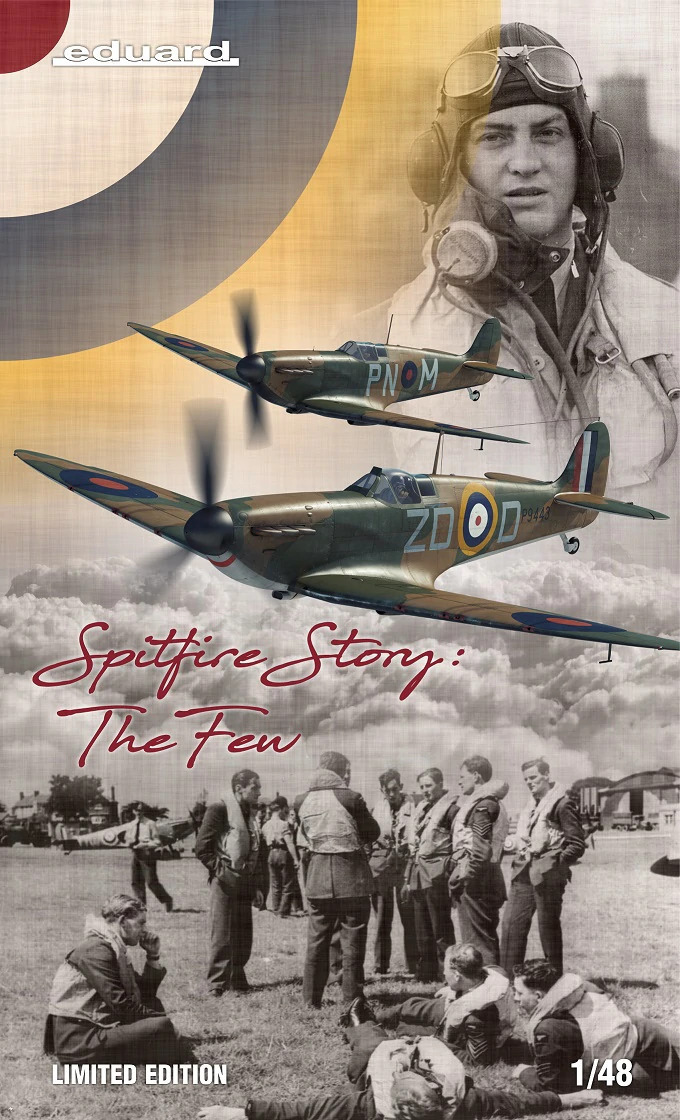
Description Limited edition kit of british WWII aircraft Spitifre Mk.I in 1/48 scale. Focused on machines from introduction into service to the end of Battle of the Britain. plastic parts: Eduard marking options: 10 decals: Eduard PE parts: yes, pre-painted painting mask: yes resin parts: yes, figurine of Douglas Bader Marking options: A) K9795, No. 19 Squadron, RAF Duxford, Cambridgeshire, October 1938 No. 19 Squadron was the first RAF unit to reinforce its arsenal with Spitfires. Two reasons influenced this decision: the airfield dimensions in Duxford and the personality of S/Ldr Henry Cozens, who was a qualified aircraft engineer, fully competent to collaborate with Supermarine engineers on the improvements of the Spitfire design. Cozens himself flew the Spitfire K9789 for the first time on August 11th, 1938. The represented camouflage and markings were used by No. 19 Squadron on October 31st, 1938, when new unit??s Spitfires were officially photographed from a Blenheim Mk.I. Note the Cozens K9794 was already equipped with the bulged canopy, which was officially introduced a few months later in January 1939. The squadron suffered its first loss on November 3rd, 1938, when P/O Sinclair, who was later a CO of A-flight of No. 310 (Czechoslovak) squadron, destroyed his Spitfire Mk.I K9792 during landing. Pay attention to the interesting feature on the leading edge of the vertical stabilizer, which prevented the parachutes strings to entangle in case of an emergency bail out. B) No. 41 Squadron, RAF Catterick, North Yorkshire, Spring 1939 The No. 41 Squadron acquired their first two Spitfires Mk.I K9831 and K9832 on December 30th, 1938 as third Fighter Command unit. This Spitfire Mk.I PN-M has a colorway from the spring of 1939, with red-blue national insignia on the upper surfaces, former white and yellow rings are oversprayed with camouflage color. Technically the aircraft displays first clean serial finish, with Merlin II engine, Weybridge two-blade wooden propeller, flat canopy, and the original old style Pitot tube. The plane doesn??t have the machine gun heating and was flown without any armor. This aircraft had an external camera gun on the upper side of the right wing. Until September 3rd, 1939, the day when UK declared war to Germany, in total 306 Spitfires Mk.I were brought into RAF, 187 of them served in eleven Fighter Command squadrons. Of these units, only seven were battle-ready two days after the war began, and four others were in the process of reinforcement and upgrades. 36 Spitfires were lost before the war during various accidents. After the war broke out, all the Spitfire equipped squadron remained based in British islands as part of Air Defense of Great Britain. C) K9906, flown by F/O Robert Stanford Tuck, No. 65 Squadron, RAF Hornchurch, Essex, Summer 1939 This Spitfire Mk.I already has the bulged canopy, three-blade propeller De Havilland and machine-gun heating. Still remains without any armor, having the old type of Pitot
Key Specifications
- Scale: 1:48
(ED11143)
| SKU | ED11143 |
| Barcode # | 8591437551217 |
| Brand | Eduard |
More From This Category
In Stock