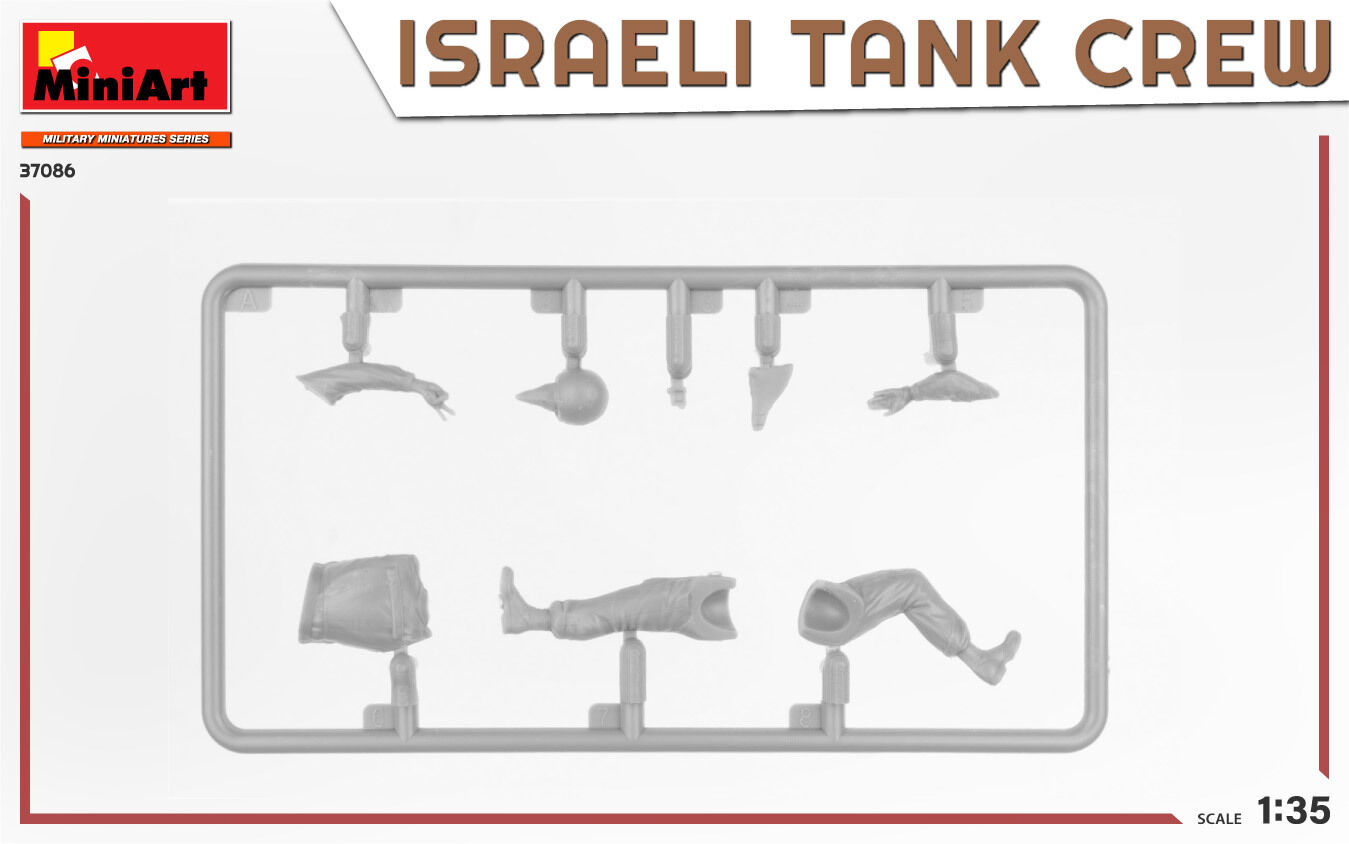
Box Contains Models of Four Figures of Israeli Tank Crew.
The Yom Kippur War, also known as the Ramadan War, the October War, the 1973 Arab–Israeli War, or the Fourth Arab–Israeli War, was an armed battle between Israel and a coalition of Arab states commanded by Egypt and Syria from October 6, 1973, to October 25, 1973.
The majority of the fighting took place in the Sinai Peninsula and the Golan Heights, both of which Israel conquered in 1967, with some fighting also taking place in African Egypt and northern Israel.
Egypt's main goal in the war was to secure a foothold on the Suez Canal's eastern bank and then use that position to negotiate the return of the rest of the Israeli-occupied Sinai Peninsula.
On the Jewish holy day of Yom Kippur, which had fallen on the same day as the Islamic holy month of Ramadan that year, the Arab alliance launched a surprise attack against Israel on October 6, 1973.
Egyptian and Syrian soldiers invaded the Sinai Peninsula and the Golan Heights, respectively, after crossing their respective ceasefire lines with Israel.
Following the commencement of hostilities, both the US and the Soviet Union embarked on huge resupply operations for their respective allies, resulting in a near-confrontation between the two nuclear-armed superpowers.
The combat began with the Arab coalition's enormous and successful crossing of the Suez Canal; Egyptian forces stormed Israel's ceasefire lines and moved practically uncontested into the Sinai Peninsula.
Three days later, Israel assembled the majority of its soldiers and halted the Egyptian offensive, resulting in a military standoff.
Syria's onslaught on the Golan Heights was timed to coincide with Egypt's offensive, and the Syrians made threatening gains into Israeli-held territory at first.
Israeli soldiers had pushed the Syrians back to the pre-war ceasefire lines after three days of severe battle.
The Israeli military subsequently launched a four-day deep-into-Syria counter-offensive.
Within a week, Israeli artillery began shelling the outskirts of Damascus, and Egyptian President Anwar Sadat began to worry about the Arab coalition's leadership's deteriorating integrity.
Sadat believed that seizing two vital mountain passes deeper within the Sinai Peninsula would strengthen the Arab position during post-war negotiations with Israel, therefore he ordered Egyptian forces to launch another onslaught against the Israelis, which was immediately rebuffed.
After a week of hard warfare in which both sides suffered high casualties, Israeli soldiers counter-attacked at the seam between the two Egyptian units, crossed the Suez Canal into Egypt, and steadily began moving southward and westward towards Suez City.
On the 22nd of October, a UN-brokered truce fell apart, with each side blaming the other for the breach.
The Israelis had significantly strengthened their positions by the 24th of October, and had completed their encirclement of the Egyptian Third Army and Suez City, placing them within 100 kilometres (62 miles) of Cairo, Egypt's capital.
Key Specifications
- Scale: 1/35
Full Specifications
| SKU | MIN37086 |
| Manufacturer | MiniArt |
| EAN | 4820183314147 |
| Short Description | Miniart 1/35 Israeli Tank Crew - Yom Kippur War # 37086 |
(MA37086)
| SKU | MA37086 |
| Barcode # | 4820183314147 |
| Brand | MiniArt |