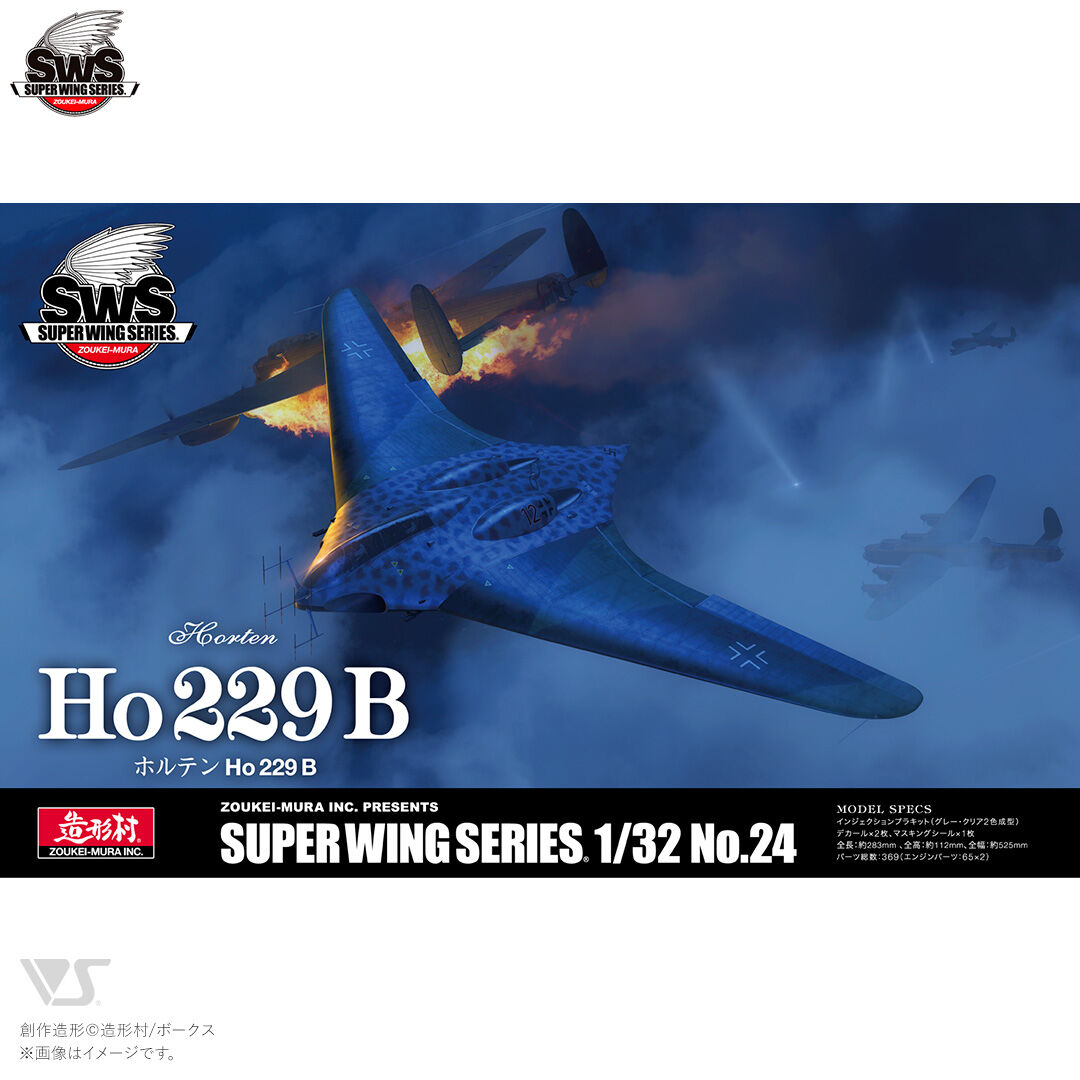
No way!! Really!!!?ã1/32 Horten Ho 229 B (Two-Seater) This new release was developed from the 1/32 Ho 229 single-seater through extensive studies and redesigns. Add this truly unique piece to your aircraft collection. This kit offers build options for either the single-seat or two-seat model and the clear exterior parts showcase the detailed internal structure. The Spirit of the Horten Brothers Revived Through SWS! From a young age, the Horten brothers were fascinated by gliders and flying wing aircraft. Under the guidance of Dr. Lippisch, designer of the Me 163, they pursued flying wing prototypes, culminating in the formal adoption of the Ho 229. Although several high-performance variants were planned, none saw combat before the war ended. Among these, the two-seat night fighter was considered the most practical. It featured a narrow tandem cockpit, with a radar operator seated in the rear, and a FuG 220 Lichtenstein radar antenna mounted on the nose, same as the He 219, for night interception. The SWS kit faithfully recreates this advanced concept as the Ho 229 B Nachtjäger, based on detailed research from actual He 219 and Luftwaffe night fighter documentation. Even under the pressures of late-war Germany, the Ho 229 B exemplified bold and forward-thinking design. Now, through SWS, this âBird of prey of the Luftwaffeâ can take flight once more in your aircraft collection. The Jumo 004 engine: the first axial-flow turbojet used in combat. Axial flow fans, also known as propeller fans, are characterized by their high airflow and low pressure, making them ideal for cooling and heat dissipation. The SWS kit meticulously reproduces the internal structure, demonstrating how air is drawn in through the intake port and transformed into propulsive force within the engine. Two tanks (four in total) are installed on each side, one in the front edge of the wing and one inside the wing. This configuration enables long-distance flight! Same as Ho 229, it is equipped with two cannons (one on each side) at the base of the main wings! Two additional guns (four total) have been added to the base of ③ and ④! If attacked by two types of cannons (six total), even a bomber would be no match. The two-seater night fighter features a narrow front-rear tandem cockpit. The rear cockpit has a radar scope. This SWS kit reproduced a windshield that is integrated with the nose section, just like the real aircraft! Since this is a night fighter, an additional light has been added for use when moving on the ground. To accommodate a tandem cockpit, the forward fuselage and nose were extended. This flying wing design lacks vertical stabilizers, reducing radar reflection. Carbon-based paint enhances stealth. The wings were made of wood and incorporates a 1.05° washout to reduce drag and improve fuel efficiency. Flying wing aircraft, which cannot be equipped with high-lift devices to enhance lift, inherently require higher landing speeds. Due to the difficulty of landing at a high angle of attack (the angle between the line of sight and the horizontal plane), they must maintain a level attitude during touchdown. Consequently, landings rely more heavily on the nose landing gear. Like the Ho 229, the Ho 229 B has a large nose wheelâsame size to the Do 335âs main gearâand reinforced struts to withstand the impact of takeoff and landing with high-thrust jet engines. Notably, while real aircraft tires typically bear the manufacturer's logo, this model features a deliberately altered design with the fictional âOONTINENTALâ branding by Zoukei-Mura. In flying wing aircraft lacking conventional tail structures, control surfaces serve multiple roles, primarily for attitude control. The outer surfaces function as elevonsâacting as elevators when moved symmetrically and as ailerons when moved asymmetrically. The center and inner surfaces, originally intended to operate similarly, appear to have been restricted to downward movement to facilitate nose-down control. Deceleration systems include air brakes and a drag chute mounted on the underside of the rear fuselage. Drag rudders, installed on both upper and lower wing surfaces, serve the yaw control function of traditional rudders. When deployed, they generate asymmetric drag, slowing the corresponding wing and enabling directional control. These features exemplify the ingenuity embedded in the aircraftâs boomerang-like design. The original SWS kit âHo 229â is based on the unfinished prototype âHo IX V3â, reconstructed as a hypothetical operational single-seat fighter-bomber, assuming it had entered combat. In contrast, the new âHo 229 Bâ represents a two-seat night fighter modelâone of the more practical designs among the proposed models. Both models use the same Jumo 004 axial-flow turbojet engines, but their cowlings differ due to changes in nose design. The Ho 229 features a smoothly contoured cowling that blends into the upper fuselage and extends toward the front intake. In contrast, the Ho 229 B has a shorter, more sharply defined cowling, tapering forward and ending near the center of the upper fuselage. The Ho 229 featured a prototype-style cockpit framed with pipes and metal panels, exposing the pilot to intense noise and vibration from the adjacent Jumo 004 engines. The nose gear was directly connected to the fuselage frame, leaving the pilotâs footwell open to the ground and subject to significant landing impact. In contrast, the Ho 229 B adopted a tandem-seat layout, similar to modern combat aircraft, to accommodate night-fighting equipment, radar systems, and improved crew protection. The cockpit evolved into a bathtub-style enclosure with internal walls, reportedly planned to include armor plating on the bottom and sides. The nose gear was mounted to the reinforced cockpit floor, enhancing both structural integrity and pilot safety. Both aircraft share the distinctive boomerang-like silhouette characteristic of flying wings. However, when compared side by side, the Ho 229 appears more compact due to its shorter nose, closely resembling a true boomerang. In contrast, the Ho 229 B features an elongated, sharply contoured nose to accommodate the tandem cockpit, resulting in a more pointed profile. This modification also extends the engine intakes forward. Combined with the nose-mounted antenna, the Ho 229 B presents a more unconventional and striking appearance. â Ho 229 A-0 White 14, ISS I./JG 44, Mainland Germany, Oct. 1945 The differences between ordering from Volks USA and Volks Japan are:
(ZM-SWS24)
| SKU | ZM-SWS24 |
| Barcode # | 4518992233338 |
| Brand | Zoukei Mura |

![A&A Models 1/48 YAK-11 Plastic Model Kit [4801]](/assets/thumb/AAM4801.jpg?20221212181555)